With the ongoing energy transition, integrating renewable energy sources (RES) into power grids has become a global priority. However, the large-scale introduction of RES into the energy mix presents major challenges, particularly regarding stability of the electric network.
Renewable energy sources such as solar and wind often rely on power electronic converters (inverters), which differ significantly from traditional synchronous generators. Their large-scale integration considerably alters the dynamic behaviour of the electrical network, raising several stability issues. These include low system inertia, voltage control, source synchronisation and disturbance response. Such challenges are particularly critical in isolated grids or networks with low short-circuit capacity.
Capsim has analysed the stability issues arising from the increasing integration of renewable energies into electrical networks, which present significant challenges in terms of dynamic stability.
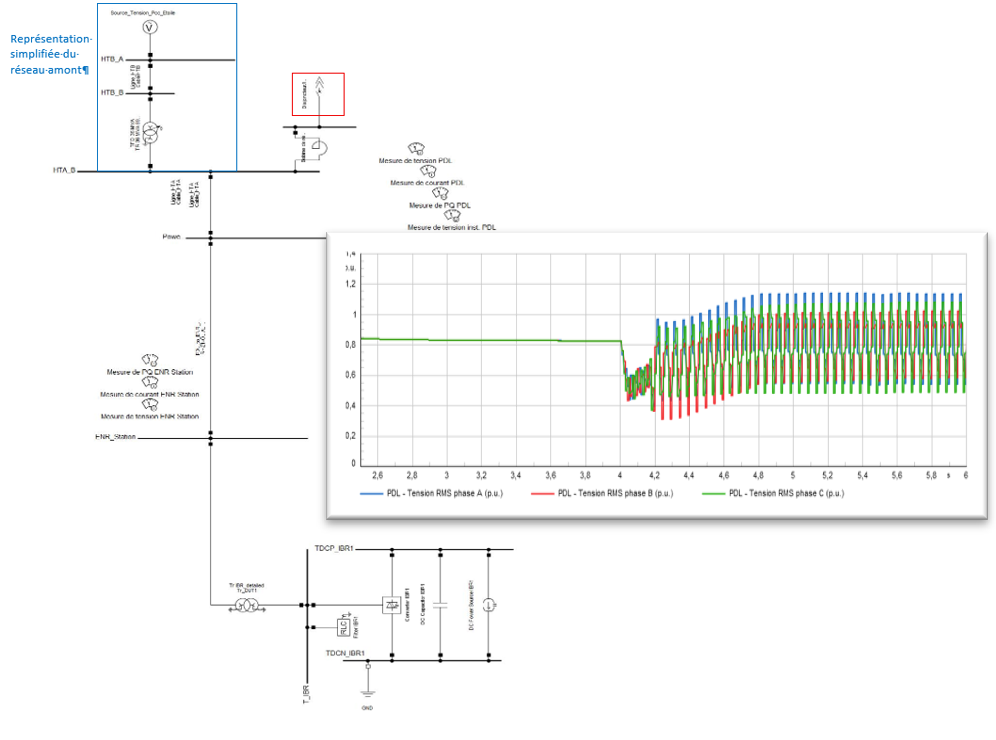
The lack of inertia associated with replacing rotating alternators by converters (PV systems or full-converter wind turbines) is now a well-known and mastered phenomenon. As the share of converters continues to increase, a new phenomenon is emerging: instabilities related to a low Short Circuit Ratio (SCR). The SCR is an indicator of the strength of an electrical grid at the point of interconnection with a generation source. Under certain conditions, increasing RES penetration may cause the SCR to fall below thresholds for which grid stability is compromised.
This issue remains relatively unknown to industrial stakeholders and developers of RES generation and storage projects. Failing to detect and address it early in a project can:
- Limit the development of RES and storage facilities;
- Limit or prevent the commissioning of a RES plant or storage facility even after it has been built;
Theoretical SCR values indicate:
- A low SCR (below 2) indicates a weak system;
- A high SCR (above 3) indicates a strong system;
- A critical SCR (2 < SCR < 3) suggests that operational difficulties may be expected.
It is a useful indicator to gain an initial understanding of the network’s strength. It helps to identify potentially at-risk areas, but it is not sufficient on its own to confirm system stability. A low SCR generally increases the likelihood of stability issues, but it does not allow for precise prediction of the type or timing of potential failures. It does not automatically mean that instability will occur, as this depends on the equipment type, its control systems, and the network context. This is why case-by-case analysis is essential.
To provide operational solutions to its clients, Capsim has led internal R&D activities with the main objective of analysing stability issues related to the growing integration of renewable energy sources into electrical networks, and more specifically those linked with the SCR.
The R&D task therefore focused on understanding the effects of a low SCR on system stability, as well as identifying solutions to address them during early project phases, study phases, or expert assessments.
RMS (Root Mean Square) studies generally do not allow detection of instabilities related to a low SCR. It is therefore recommended to use electromagnetic transient (EMT) simulations to accurately assess stability in such situations.
Following this research, Capsim achieved:
- A detailed understanding of the underlying phenomena and the influence of the different involved parameters, enabling improved early detection of high-risk situations;
- Proficiency in the level of detail required in equipment models to predictively simulate instability phenomena associated with SCR;
- Proficiency in simplifying assumptions that ease studies of the phenomena associated with low SCR;
- Definition of design rules, operational strategies, or mitigation solutions when instability is confirmed.
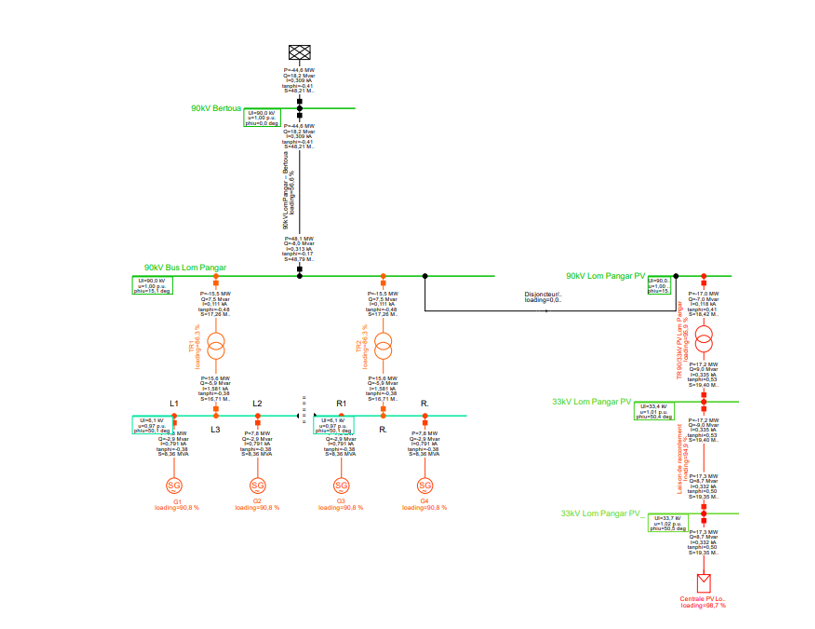
These R&D actions have made it possible to address several real industrial cases, both in early project phases (design of systems integrating power generation, BESS storage, hydrogen production, etc.) as well as in incident investigations