Power grid studies
Insulation Coordination Studies
Background
In high-voltage networks, electrical equipment is exposed to overvoltage of internal origin (switching operations, faults) or external origin (lightning strike). The dielectric capacities of the equipment must be properly sized to prevent insulation failure. IEC standards (such as IEC 60071) provide the framework for the insulation coordination process.
Requirement
Operators must ensure that every piece of equipment in the facility (transformers, circuit-breakers, switchboards, cables, surge arresters, insulators, etc.) has a sufficient insulation level with respect to the overvoltage that can be expected.
Without a prior study, the network is exposed to:
- Risk of equipment damage;
- Non-compliance with standards.
Principle :
An insulation coordination study consists of:
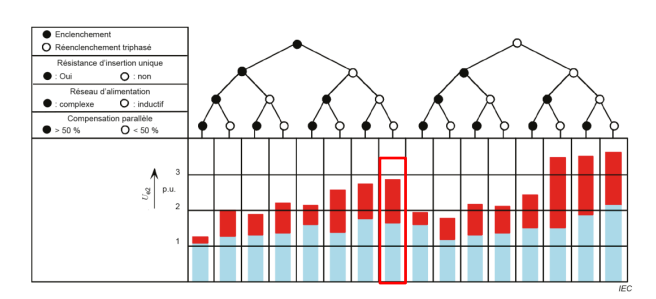
- Analysing the electrical diagram and identifying possible sources of overvoltage across different categories: power-frequency overvoltage, slow-front overvoltage, fast-front overvoltage;
- Defining the required insulation levels in accordance with IEC standards (calculations based on a probabilistic approach);
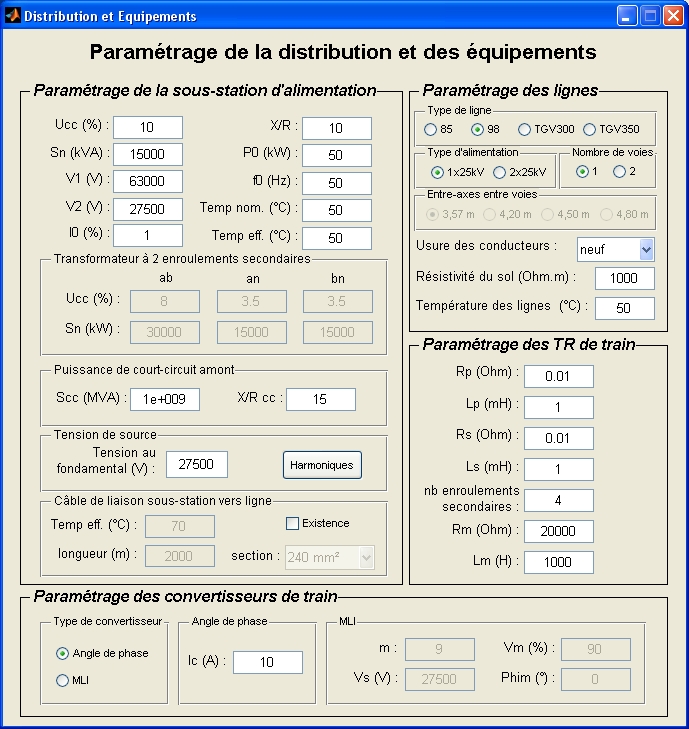
- Simulating network behaviour under overvoltage conditions using EMT (electromagnetic transient) simulations in a dedicated software;
- Sizing or approving protective devices (surge arresters, etc.).
Results
The client receives:
- A normative validation of insulation levels;
- An optimised selection of equipment adjusted to the overvoltage prone to appear on the network.